“I’ve never seen ADK control a robot. And doing it for science, wow.” — Katie O’Leary, Google
TL;DR
- Team MIKMAK used Google’s ADK to plan and coordinate a 24-hour robotic screen of TEM-1 β-lactamase, and took first place at the AI for Science World Models Hack.
- The agent chose tools and filled in their arguments while Python did every calculation, and no agent could start a physical run without a scientist approving it.
- Rearranging Zeon’s existing robot skills, rather than writing new ones, took a run that had needed 30 minutes for 11 wells down to 20 minutes for 48.
Team MIKMAK joined Google’s August ADK community call to share what they built at the AI for Science World Models Hack, which we organized with Zeon Systems.
In about 24 hours, the team designed and ran experiments on a robotic lab platform to study TEM-1 β-lactamase, an enzyme involved in antibiotic resistance, and test compounds for inhibition. The project took first place.
Mohammed Ahsan Fuzail, Kevin Lau, and Karthik presented the work on the call. Their teammates Isobel and Manoj couldn’t join. The name MIKMAK came from the team’s initials: they were in a rush to start building, and it sounded good.
The team used Google’s Agent Development Kit (ADK) to help plan experiments and coordinate the workflow. Scientists reviewed the proposals, approved what could run, and started the hardware themselves.
Labs already have robots and software that tracks samples and results. As Kevin explained, the problem is that these systems don’t always share a record. Scientists often carry the missing context in their heads. An agent can only work with what has been written down.
To keep track of the experiments, the team connected ADK with Zeon’s robot controls, repurposed beads as an audit log, and used marimo notebooks for approvals and analysis. This supported the full design, make, test, and analyze cycle, with a record of what was proposed and what actually happened.
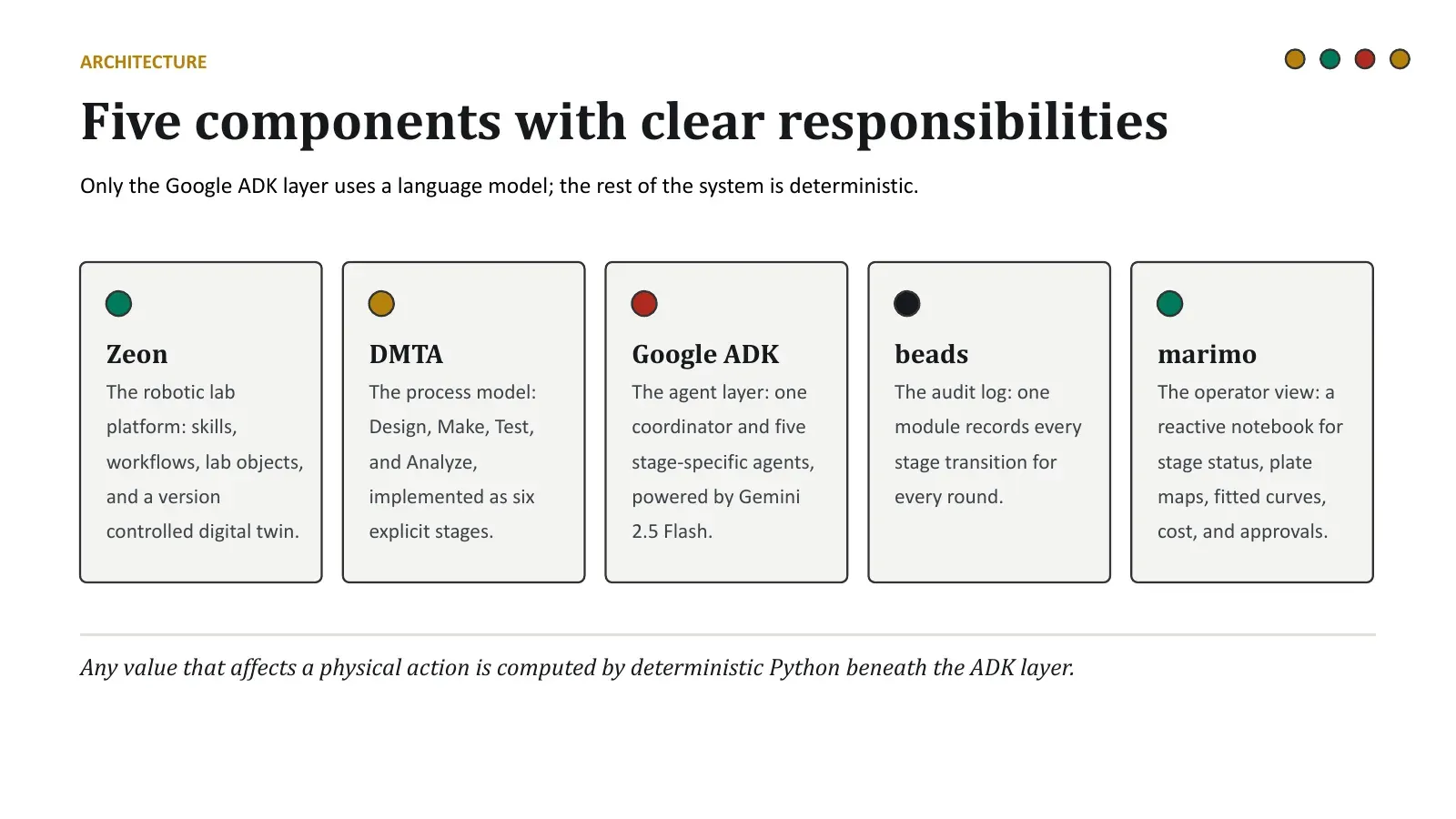
The agent selected tools and supplied their arguments. The tool layer checked those arguments, and Python handled calculations such as liquid volumes, plate layouts, and pipetting limits. Only the ADK layer interacted with the language model.
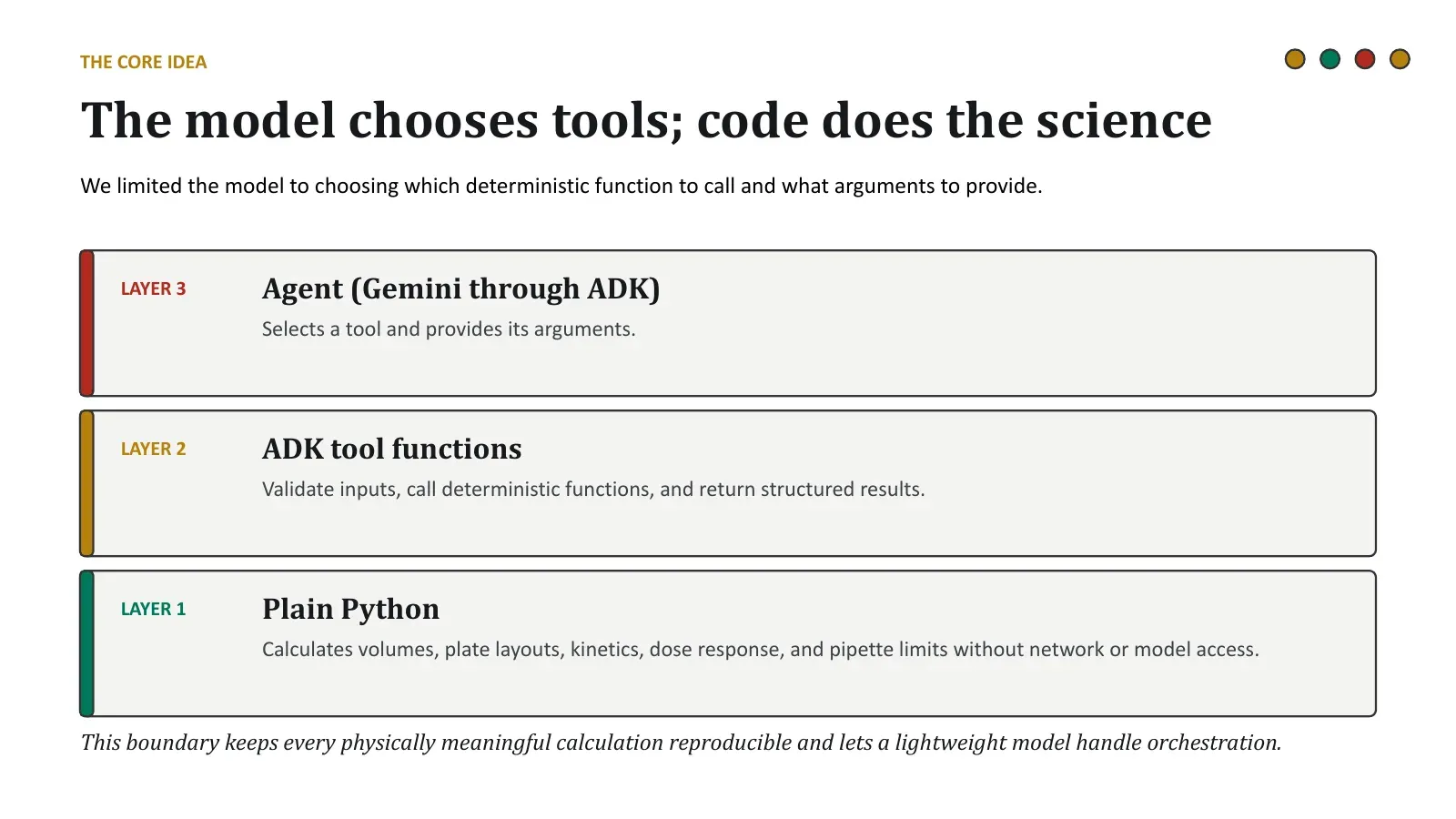
Kevin described how they limited the agent’s control over the hardware: “We just don’t build a tool, and it can’t call what doesn’t exist.”
No agent could start a physical run, and changes couldn’t sync to Zeon without explicit approval. After an experiment, the agent checked the logs to see which wells had actually run. Failed or altered runs stayed in the history, including results that didn’t match the expected fit.
Zeon supplied about 30 robot skills and 19 calibrated object models. By arranging those existing skills into workflows, the team built two assays without writing new robot code.
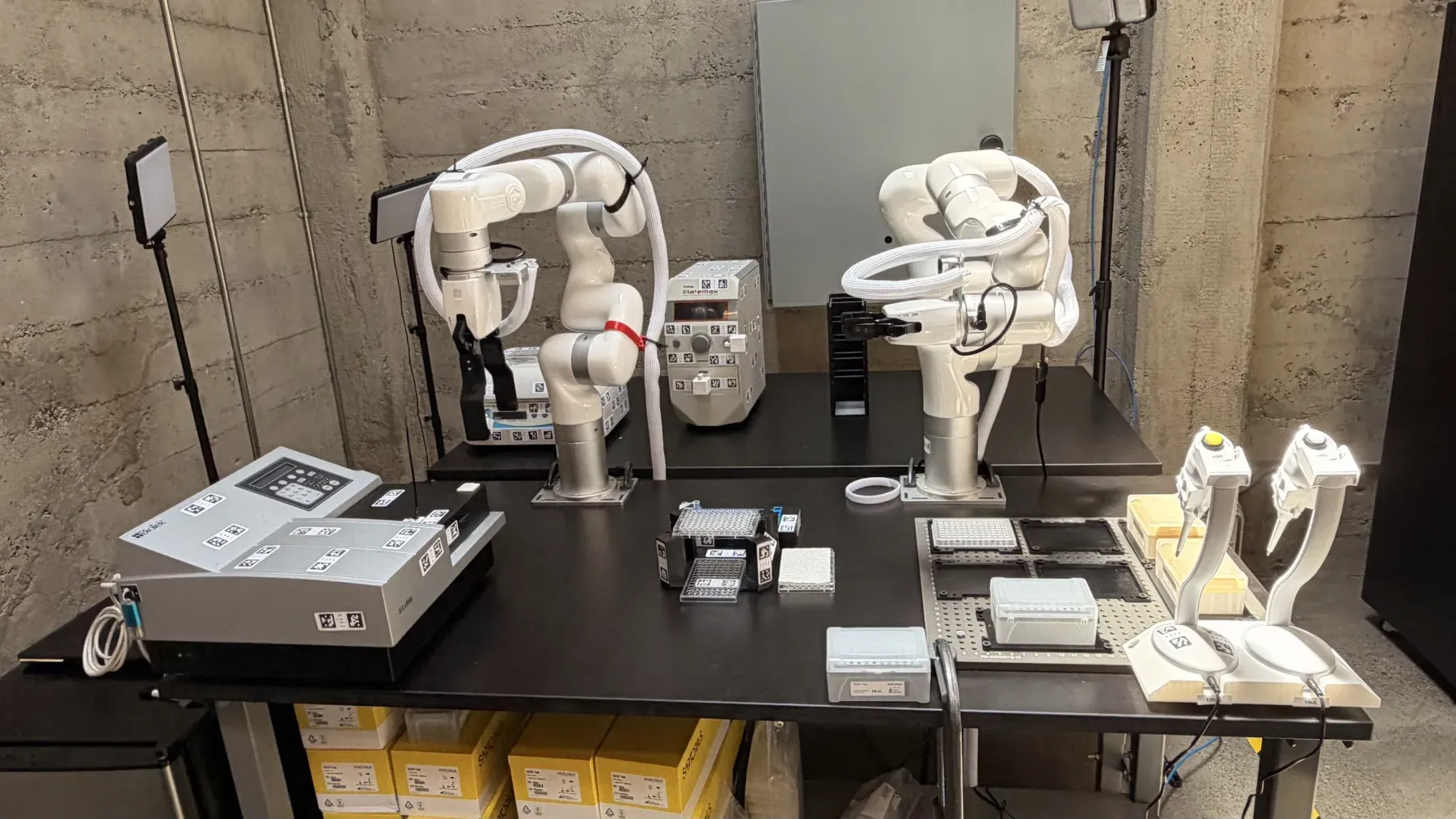
That also made it easier to improve the experiments. After watching the first run, they noticed the robots were making unnecessary movements. Kevin rearranged the workflow in minutes: a 120-action run dropped from 33 minutes to 19, and a run that had taken 30 minutes for 11 wells covered 48 wells in 20.
For the interface, Ahsan used adk web, only learning afterward that it was intended for development and debugging. It gave the team a way to chat with the agents without building a separate front end.
The marimo dashboards let scientists inspect planned, completed, and altered runs, down to the volumes used for individual samples. The team also used token counts from ADK’s session database to estimate agent costs alongside the experiment records.
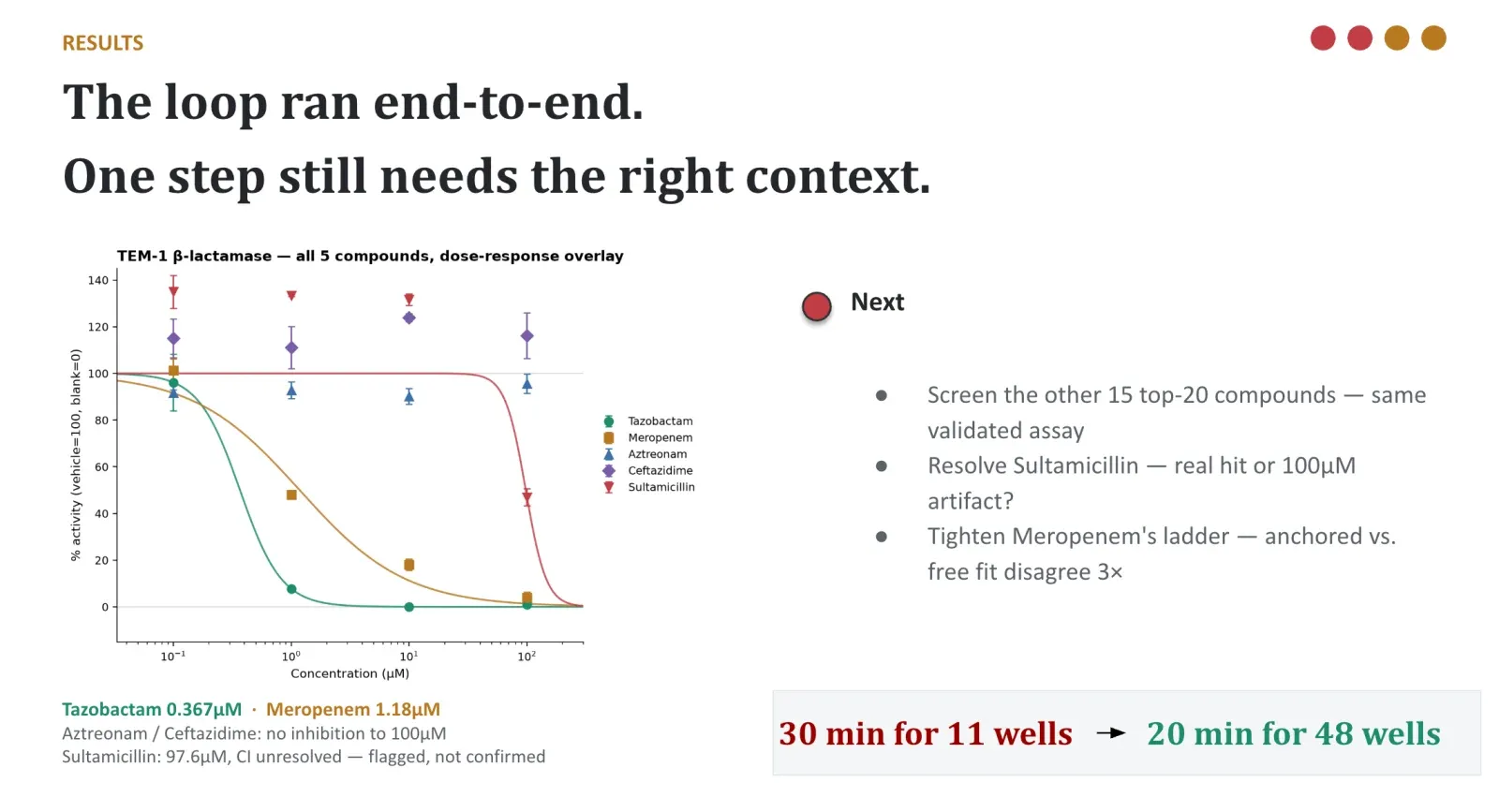
By the end of the hackathon, real robot arms had handled samples and produced results that the team could check against manual runs. On the Google call, they walked through how they made that work, and where a scientist still needed to step in.
The code is on GitHub. Thanks to Zeon Systems for hosting and the hardware, Sepia Bio for the CFPS kits, and all other partners for the hack.