“Real innovation.” — Chiu, Founder of Openshelf and Opentrons
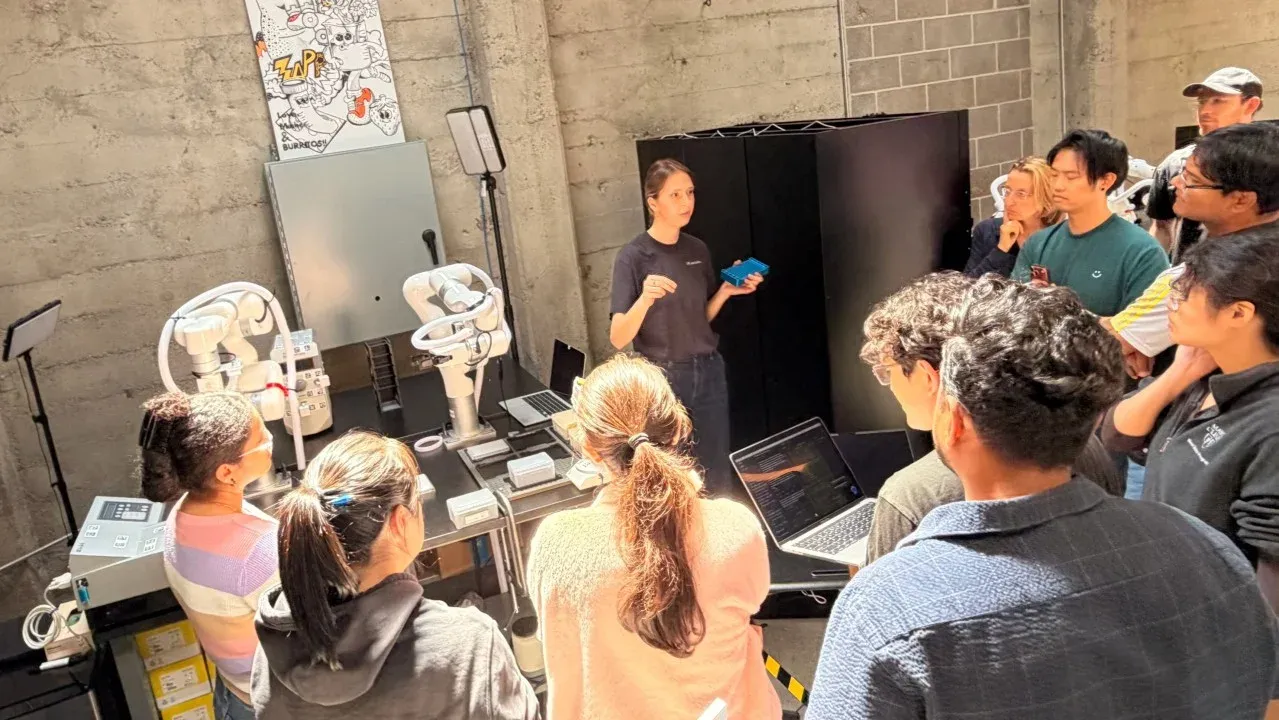
More than 300 people signed up for this hack to build with the latest AI, hardware, and biology tools—and to see what the teams could ship. Hosted by Zeon Systems, the weekend offered three tracks for builders with different backgrounds to tackle ambitious projects.
This was also a notable week for the AI for Science community. The U.S. government committed more than $5 billion to expand the Genesis Mission, announced its first 250+ autonomous science projects, and published the report Science, A New Golden Age.
After six hardware hacks, we have heard the same limiting beliefs repeatedly:
- “I need a multimillion-dollar lab and a large team to get started.”
- “I need a PhD in robotics to start building,” or “I need a PhD in biology to start experimenting.”
- “I’ll try new tools every three years in our lab.”
The reality looks different:
- Autonomous science can start with a Raspberry Pi and an inexpensive arm. Production hardware such as UFactory xArms can integrate at a fraction of the cost of traditional workcells.
- Coding agents, agent development kits, and co-scientist tools let anyone who can describe an idea in natural language explore technical subjects once gatekept by credentials.
- Capabilities now change month over month. If you are not experimenting every four to six months, you are missing what has become possible.
That is why we host weekend hacks two or three times a year: they create a space for community experimentation. Over 24 hours, teams tackled end-to-end cell-free protein synthesis, new robotic dexterity challenges, and scientific agents built with Google’s ADK.
The setup with Zeon Systems’ platform
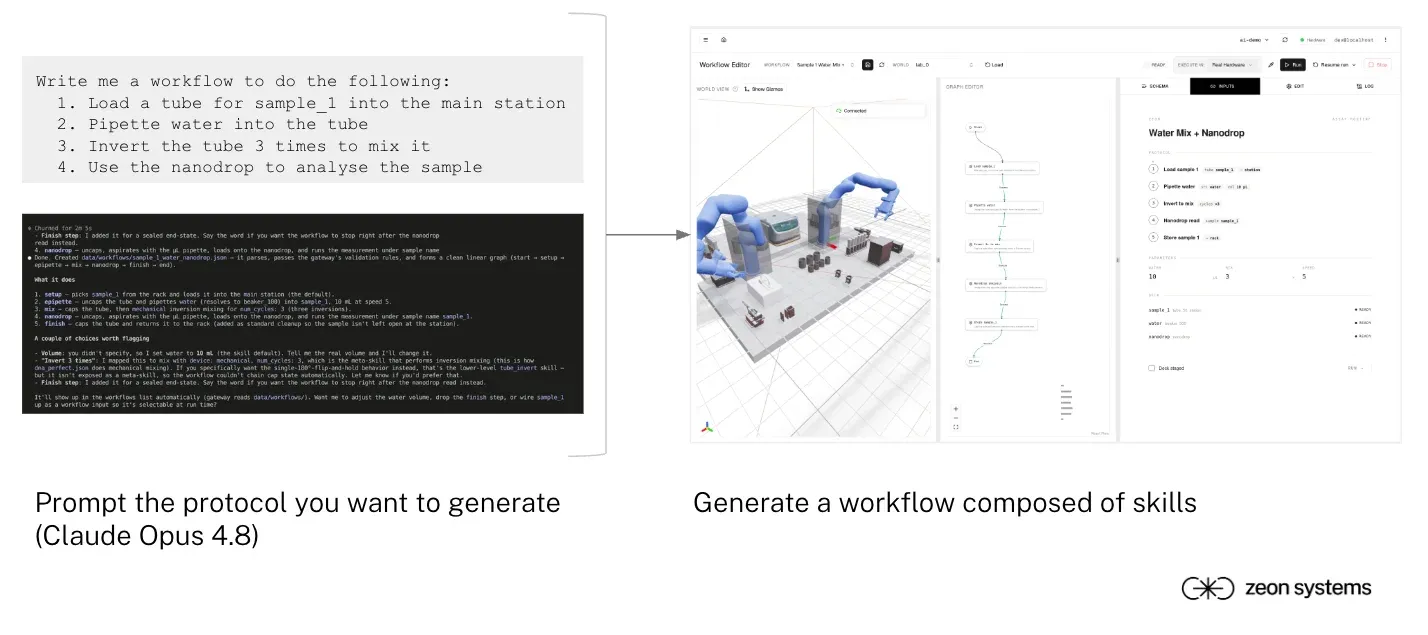
The previous hack featured an MCP-controlled workcell. This time, teams used the Zeon Systems platform to build robotic workflows with coding agents.
The platform begins by scanning the benchtop with depth cameras to build a world model of the lab. That digital setup enables previews in simulation. A command-line tool then connects to coding agents, so builders can compose robotic workflows in natural language. Once a simulation runs successfully, the workflow deploys directly to the robots.
Three build tracks
Track 1: Close the Loop
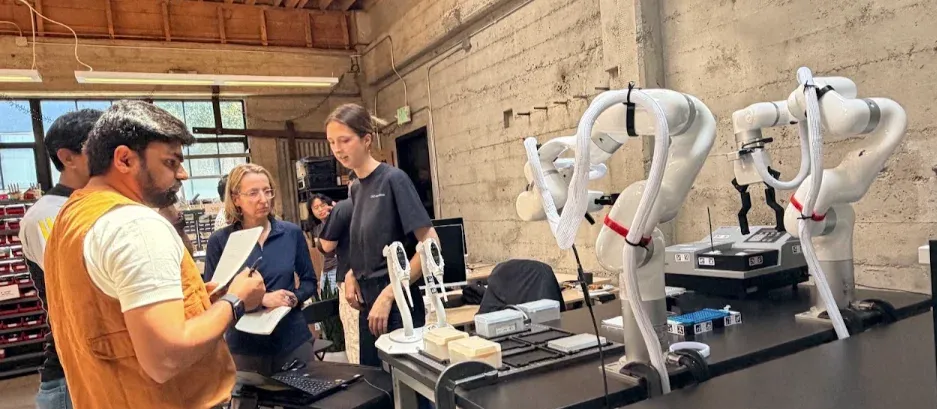
Question: Which compounds meaningfully reduce TEM-1 β-lactamase activity, and what dose-response patterns do they show?
TEM-1 is an antibiotic-resistance enzyme that bacteria use to break down penicillins. Teams built three workflows on the Zeon system: make the enzyme with cell-free synthesis, confirm it was made, screen it, and use an agent to decide what should go on the next plate. Sepia Bio supplied the CFPS kits.
TEM-1 was expressed as an sfGFP fusion, with green fluorescence as the go/no-go gate before screening. Nitrocefin was the readout, using the initial slope of A490 over time as enzyme velocity. A 95-compound library, plate sealer, incubator-mixer, and plate reader completed the workflow. The goal was to produce a better second round using what the first round revealed.
Track 2: Openshelf Integration
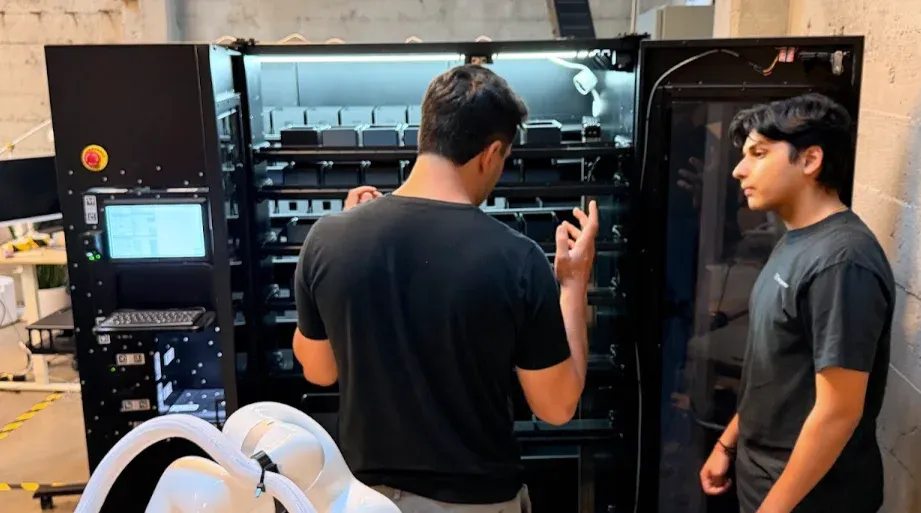
Question: How do we connect Openshelf’s automated inventory to the Zeon robotic bench?
Openshelf handles storage and retrieval; Zeon Systems handles execution on the bench. Teams had to make a complete physical handoff work: Openshelf presents an item, the robot identifies it, picks it up, and uses it without a person repositioning anything.
Another path was to extend Openshelf with modules for irregular objects, occupancy and orientation sensing, and reorientation or scanning before an item leaves storage.
Track 3: Open Dexterity and Physical Verification
Question: How can we build new robotic capabilities for the physical lab with the latest agent tools?
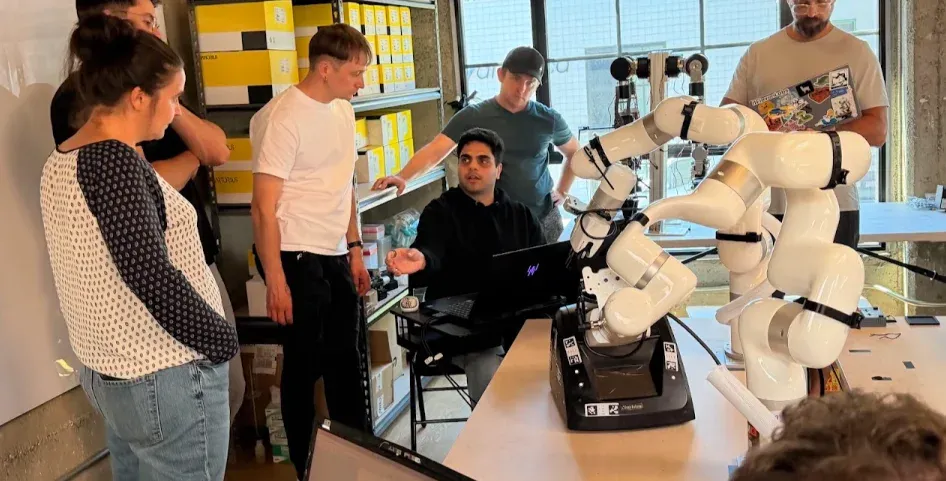
Teams worked with UFactory xArm Lite 6, YAM Arms, OpenArms, Piper, cameras, labware, Bambu Lab 3D printers, and the Zeon simulation and control environment.
The prompt had two halves: hard physical tasks that human-centered instruments make awkward for robots, and systems that verify whether an action actually succeeded—then retry, stop, or ask for help. BioKEA also brought its automated BugPicker for cross-instrument integration.
Eight teams shipped new projects in 24 hours
1. Team MIKMAK — Overall Winner
Team: Manoj Khadka, Mohammad Ahsan Fuzail, Isabelle Lehoux, Karthik Ravi, and Kevin Lau
Problem: Closing the loop once is a demo. Closing it repeatedly, while retaining a scientist’s trust, is a pipeline—and the trust question is where many systems quietly fail.
Solution: A Design → Make → Test → Analyze loop for TEM-1 β-lactamase screening, run by an agent and verified by a scientist. The agent cannot start a run. Using Google ADK, the workflow has five stages:
- Plan: Select run conditions and check each leg against the pipette’s real range.
- Simulate: Validate deterministically and sync values into the workflow the app opens.
- Approve: A human reviews the plan and simulation.
- Execute: The physical arm runs with indexed tips and full logging.
- Analyze: Read the plate-reader export, flag pass/fail, and feed the next round.
The team built two new assays sharing one skill library. Agentic optimization reduced a 120-action run from 33 minutes to 19, and a run that took 30 minutes for 11 wells fell to 20 minutes for 48.
Results included Tazobactam at 0.367 µM and Meropenem at 1.18 µM. Aztreonam and Ceftazidime showed no inhibition up to 100 µM; Sultamicillin came in at 97.6 µM with an unresolved confidence interval.
View the MIKMAK code on GitHub.
2. Hive Mind — Track 2 Winner
Team: Sai Thatigotla and Simon Coelho
Problem: Small-batch neural cell cultures require constant monitoring. Media evaporates quickly, cells are sensitive to environmental change, and researchers become bottlenecked by maintenance rather than experimentation.
Solution: A self-contained Culture Node with neurons on a microelectrode array, sensors, illumination, a battery, and a Raspberry Pi. Computer vision monitors media levels and raises a flag when help is needed. Thirty nodes fit into a Hive cabinet in Openshelf, while Hive Overwatch provides a REST service for registering, retrieving, inserting, reading, and refilling cultures.
When a node reports low media, storage pulls it out, an external Zeon workflow replenishes it with dual arms, and it returns to storage. The demo showed a working node prototype, loading and retrieval, and media-level detection on real hardware.
View the Zeon hackathon code and neuron lab automation code.
3. Tacit Teacher (ZPeel) — Track 3 Winner
Team: Erik Brinsmead, Taras Nazarov, Tuan Tran, and Aleksandra Denisin
Problem: The hard part of adapting a human protocol to a robot is everything the written steps do not say: force feedback, adaptive intuition, and the sound something makes when it is wrong. Plate peeling is a perfect example. Many workflows use rubber mat seals that cannot be avoided, peeling is often step one, and existing unitasking equipment has narrow compatibility and still needs supervision.
Solution: A pipeline that turns a scientist into a skill author. Record narrated successes and failures, run an agentic interview to uncover tacit knowledge, generate a Zeon workflow, then teach and test on real arms. The team shipped ZPeel, a working mechanical peeling skill. The same approach could extend to tissue grinding, centrifuge loading, protein extraction, vortexing, and labware transfer.
4. BugPicker Automation
Team: Sean Jungbluth, Jeremy Garibay, and Austin Baker
Problem: Large-scale biological discovery still depends on manual labor. Specimen picking, plate movement, imaging, sample preparation, and metadata tracking cap biodiversity work at what a person can physically do.
Solution: A robotic specimen-handling rig with a gantry and arm that cycles individual insects into wells, plus a plate shuttle designed around a hard target of $0.25 per individual for imaging and sequencing. During the hack, the team integrated an xArm into its BugPicker and imaging workcell.
Next comes downstream liquid handling, high-throughput DNA sequencing, and an agentic feedback loop that prioritizes candidates for new-species discovery.
View BugPicker automation on GitHub.
5. Biomate
Team: Anshu Gupta, Arnab Banik, Juan Pablo Montoya, and Tiffany Cheng
Problem: Closed-loop biology stalls at the seams between designing a plate, getting a robot to run it, retrieving the data, and deciding what comes next.
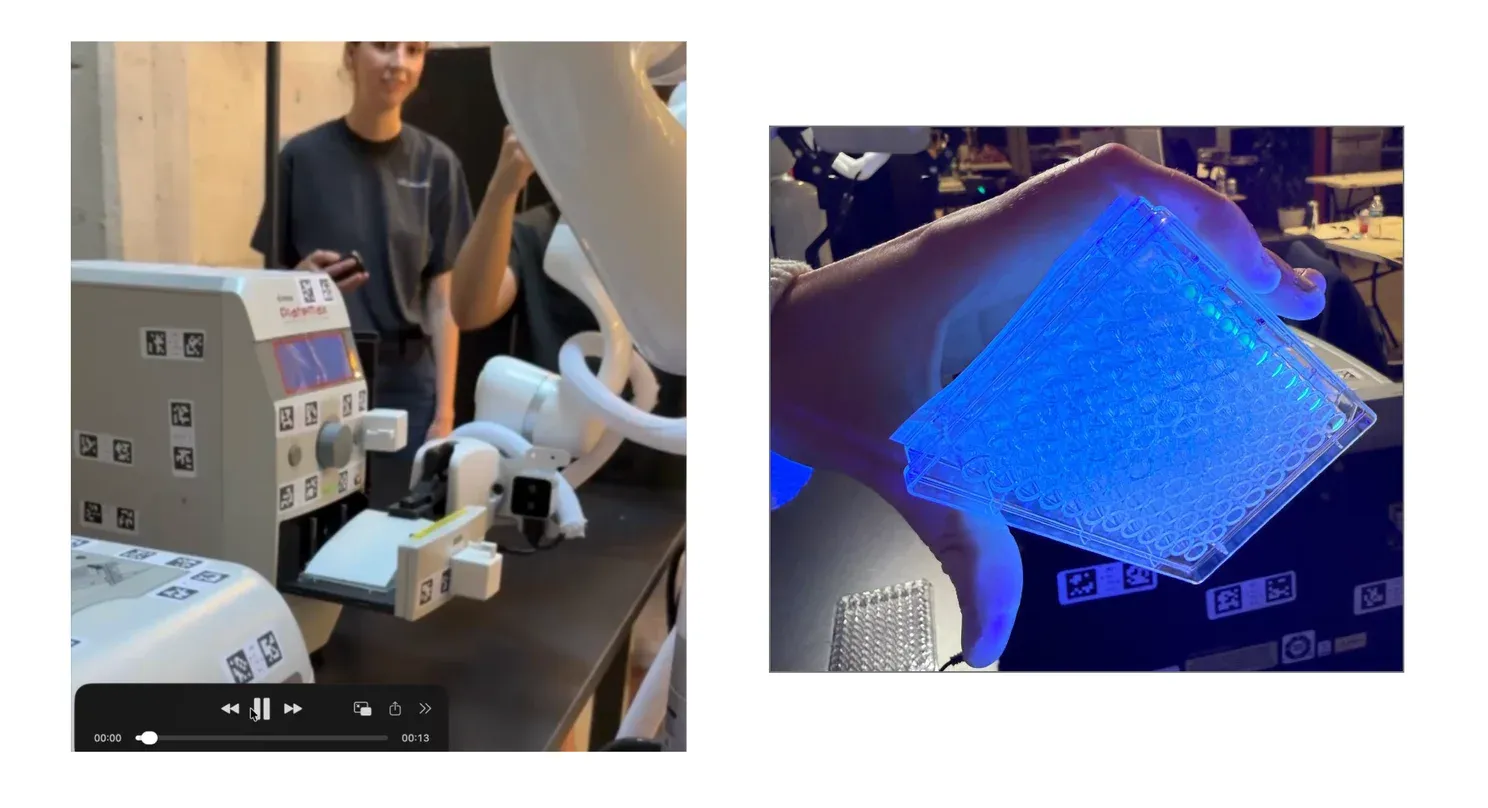
Solution: An autonomous biology platform built as one explicit loop: Design → Simulate → Execute → Collect → Analyze. The team ran two experiments through it. The first designed and executed a plate for active TEM-1, returning purified enzyme with yield and activity data. The second screened TEM-1 and a control β-lactamase against inhibitory compounds, with the nitrocefin signal driving the next round.
6. TeamFour
Team: Neil Wilson, Ryan George, Masatoshi Uehara, and Will Stock
Problem: An agent cannot request an object it has no way to name or find. Storage and the bench were separate systems with no shared handle on a physical item.
Solution: Tag objects with ArUco markers so the Zeon system can recognize and grip them dynamically, then place and store them in Openshelf. Once tagged, an item’s storage becomes automatable and an agent can query Openshelf to bring objects into the workcell. The team shipped a script that queries for the first open container of the required size and stores the item there.
7. Measuring Antibiotic Resistance with Color
Team: Rob Learsch, Philip Thomas, and Chang Hu
Problem: Assay development is where closed-loop screening often breaks. Nitrocefin cleavage by TEM-1 is fast, so delays in preparation or dispensing obscure the measurement.
Solution: A full agentic loop for assay development: a researcher LLM selects compounds and designs the plate, another writes the workflow, Zeon executes it, and a second LLM analyzes the data. An LLM-human decision tree evaluates outcomes and decides whether to loop back or optimize.
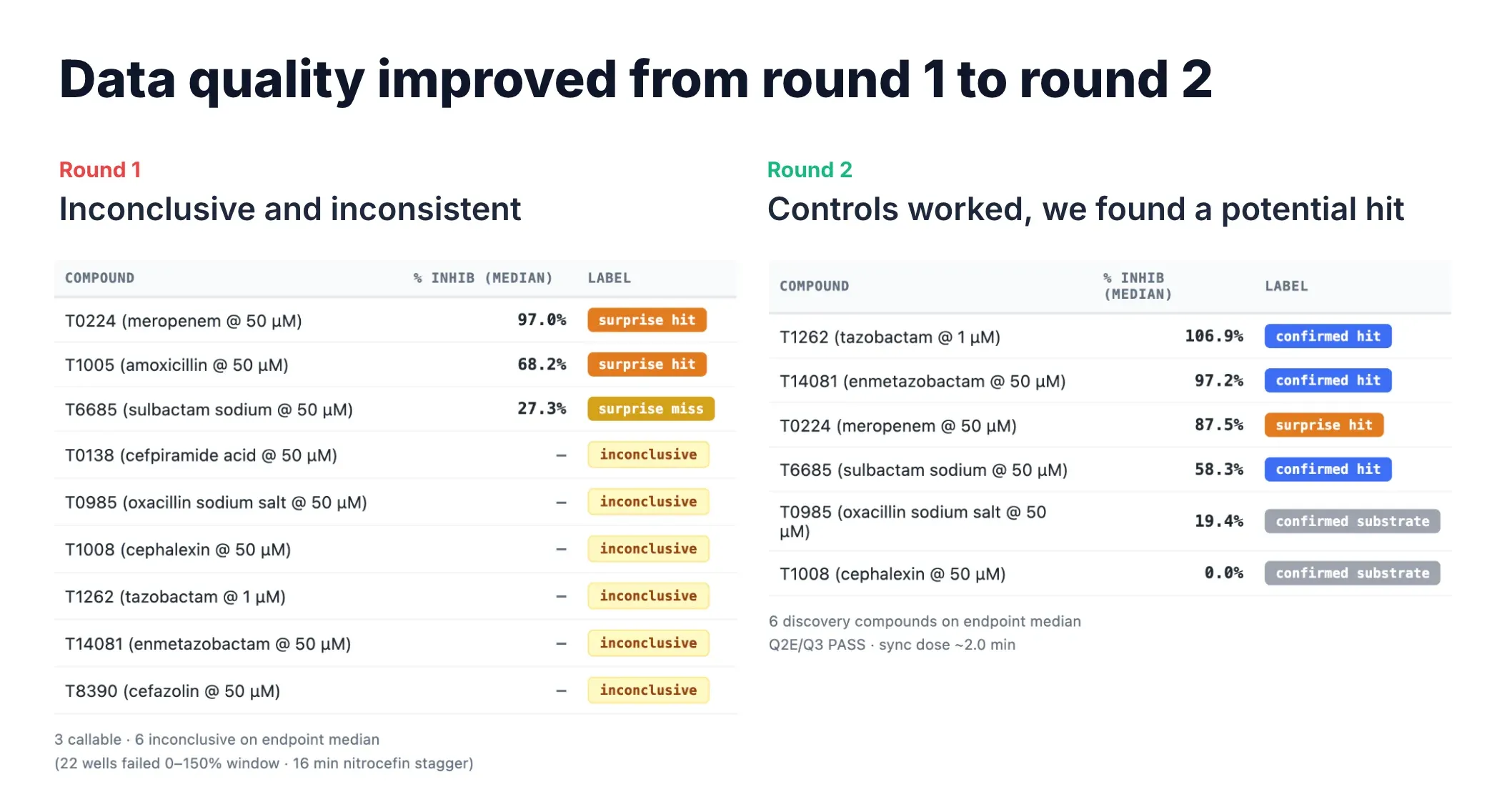
The team built flexible random-access plate mapping across many compounds. A baseline run of 2 hours 45 minutes fell to one hour in round two. The first round was inconclusive; the second produced working controls and a potential hit.
View the beta-loop code on GitHub.
8. OT OneCapped — The Robust, Collaborative Lab Cell
Team: Lukas Bromig, Dale Herzog, and Di Hu
Problem: Lab automation has two gaps. Robots freeze when reality drifts, and they cannot tell you whether a second attempt worked. Instruments and labware are also built for human hands: caps twist, tubes need support, and liquids pour.
Solution: A real sample-preparation step where every move is verified. Two arms cooperate to uncap; one transports the tube; an arm and liquid handler aspirate; and an AI vision layer confirms each step while keeping an image archive.
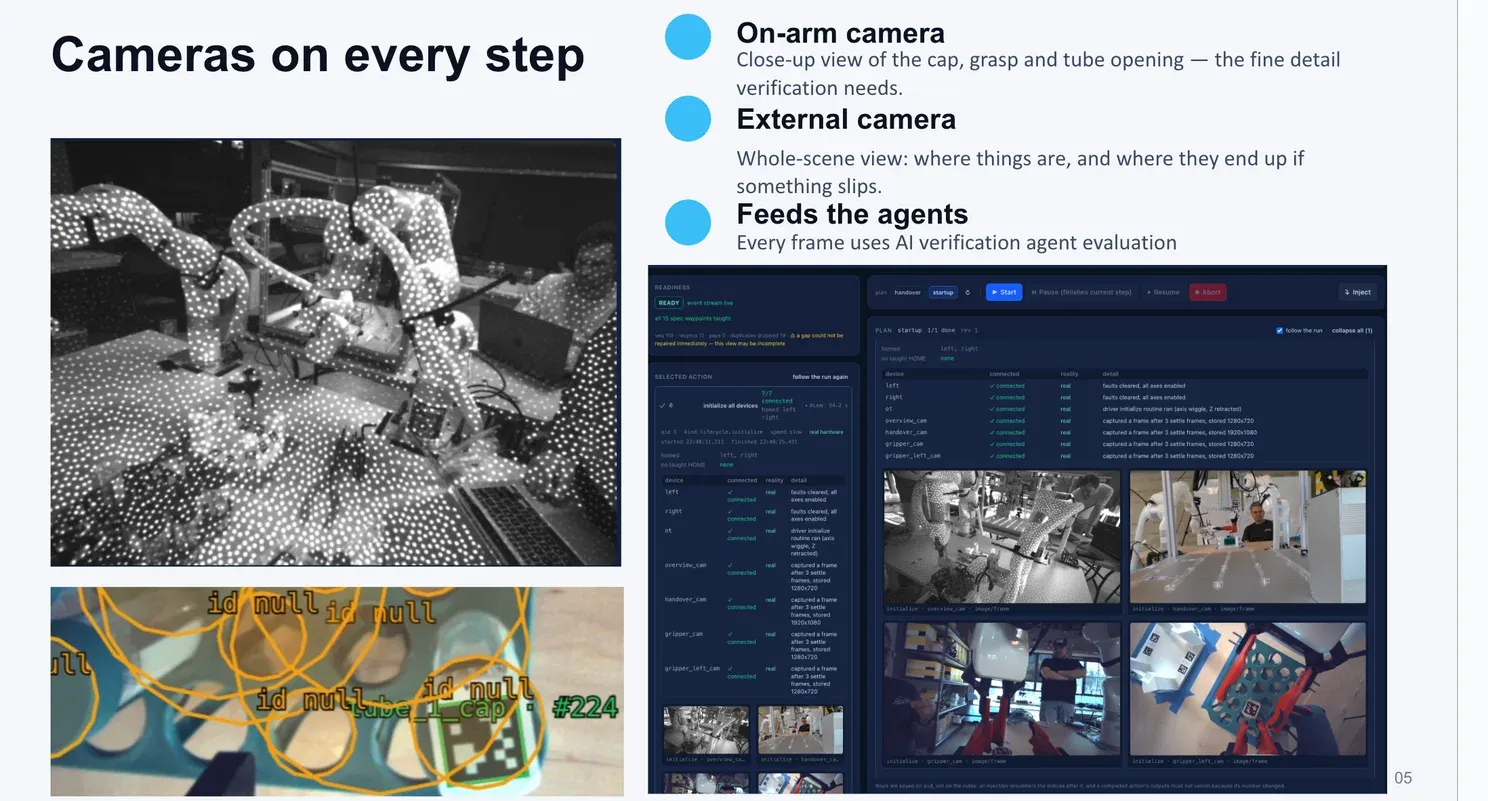
Custom grippers reach between tightly packed tubes and can grasp from the top or side. An on-arm camera handles fine-detail verification, while an external camera tracks the whole scene. The system asks a specific question at each step—“Is the cap off?”, “Is the grasp secure?”, “Is the tube aligned?”—and combines vision with torque, gripper-width, and pose signals.
The liquid handling ran on an original Opentrons OT-1, bringing first-generation equipment more than a decade old back to life with camera verification.
What is new in 2026
Across six hacks in two years, three things stand out about deploying robots in labs with agents:
- Simulation is now the development path. Teams previewed workflows in Zeon Cloud and deployed them to real arms, often in minutes rather than hours. The remaining work is final sim-to-real calibration—and eventually real-to-sim feedback.
- The bottleneck has moved into the physical world. Teams were blocked by inverse kinematics, anchor points, spatial understanding, and whether a cap actually came off—not by reasoning or code. Three of eight projects centered on verification.
- Humans belong in the design and decision loop. Scientists steering agent development and automation engineers shaping protocols produced the strongest systems. Fully agent-run decision trees remain naive to real-world experience and sparse experimental data.
These 24 hours were a starting point for faster design and execution of experiments on real hardware.
Thank you to everyone who made this possible
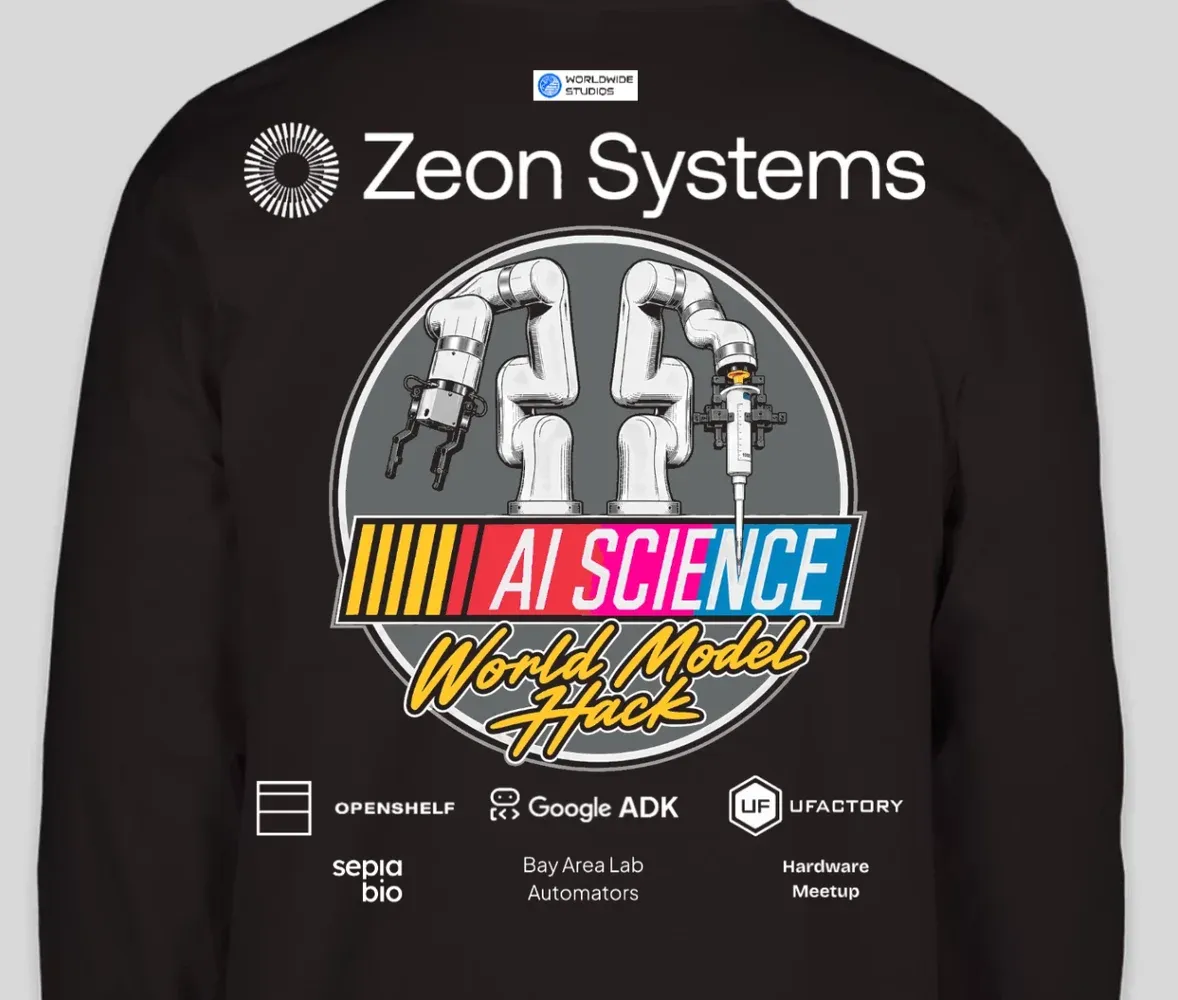
Our host and headline partner, Zeon Systems, hosted the weekend. Brontë Kolar and Tahir D’Mello led track design, hardware, project support, lab support, and food for a focused build weekend.
Technical track partners included Sepia Biosciences, Openshelf, Google ADK, and UFactory. Community partners included Bay Area Lab Automators, Luis Villa, and SF Hardware Meetup.
Gabriel McKinsey advised the first scientific track. Judges were Isaac Chan, Jimmy Sastra, Brontë Kolar, and Haran Rajkumar.
The event was organized by Worldwide Studios, an education nonprofit helping professionals build with the latest AI, robotics, and science tools to solve important problems.