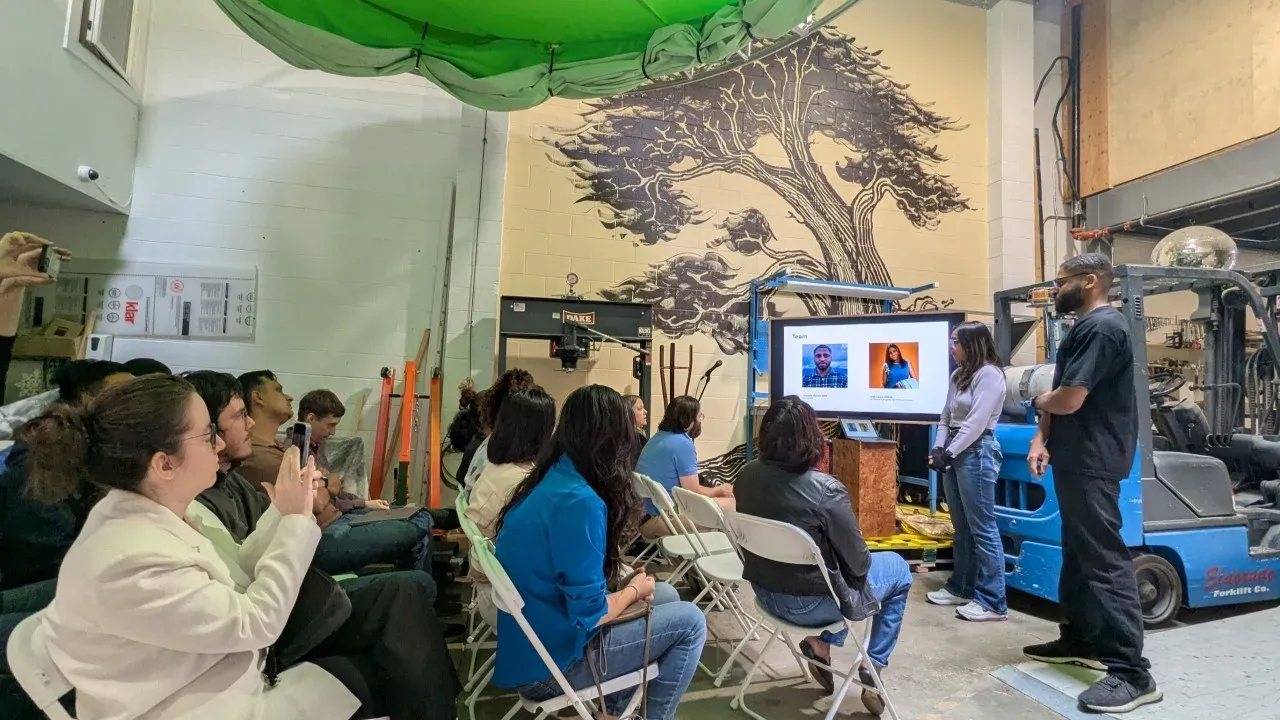
“Now that I’ve had a window into this world, Iʼm looking forward to diving deeper into building and prototyping.” Kali, ex-Headspace
With so many advancements in AI and hardware, a weekend hack is a need to have for any community serious about building the future. It’s a chance to come together and explore new solutions to longstanding problems with people of different backgrounds.
In the last month alone, major updates unlock new possibilities.
Foundation model releases like Sonnet 4 from Anthropic can be used for smarter applications or assist in quicker builds as a top-performing model for vibe coding.
New open models like Google DeepMind’s MedGemma unlocks new potential in medical copilots and assistant workflows.
Applications like Perplexity’s new lab agent help people move faster when understanding a health system and analyze a problem set.
What’s possible in June 2025 with MCP servers and new agentic tools like Cursor dwarfs what was possible one year ago for small teams tackling big problems. This weekend, teams explored:
How might we increase access to quality healthcare?
“I didn’t even know robotic microscopy was possible until this weekend. And now, we’re building with it.” — Clinical researcher
This hack took place in two countries: Clutch AI hosted the launch of a full build week in Nairobi, Kenya, and this weekend in San Francisco with Nzisa Kiilu and Dylan Holland.
For technical partners, we had Pranav Shrestha from Cephla share their sickle cell open dataset for people to build applications in early detection and diagnosis. Also, Ahmad Saleh helped set up a remote patient monitoring track for people to explore the role that sensors and data play in distributing access to care.
Teams explored different problems including emergency room triaging, novel biomarkers for menstrual health, and computational bio therapeutic pipelines for sickle cell. This overview covers what was built in SF, recap for Nairobi teams coming next week!
Here’s what got built in SF
Everyone had 24 hours to go from zero to demo. Teams were made on the spot and could explore problems they wanted to see solved.
Asha - AI health hackathon Asha - AI health hackathon Nitin Goel
Asha 🏆
Problem: Reliance on paper records leads to scattered, incomplete patient data, duplicate tests, and difficulty sharing information among providers.
Solution: Scan and digitize paper records, use AI to interpret and fill gaps in health data, then securely share structured records with providers.
Team: Nitin Goel Nick Retallack
Sickle cell diagnostics with Octopi
Problem: Existing sickle-cell testing in low-resource settings is slow, error-prone, and requires specialized personnel, delaying diagnoses and treatment.
Solution: Deep learning powered digital microscopy to rapidly and accurately distinguish sickle cells from normal cells
Team: Monika Ahirwar Rene Ravenel Natalie Marie Sober
TriageX
Problem: Manual triage clogs emergency rooms throughput, where nurses spend 30 % of shifts on paperwork, median wait times exceed 3 hours, and patient “left without being seen” rates up to 30%.
Solution: A mobile self check in system with mutlimodal triage using video and voice for self intake. The risk scoring will help automate prioritization to cut admin time to zero.
Team: Chimere David Ogudu Aishwarya Jadhav
SuppSafe
Problem: Consumers face rising risk of harmful interactions among dietary supplements, but there is no widely accessible, reliable tool to flag dangerous combinations.
Solution: A web-based interaction checker that aggregates case data, flags contraindications, and provides clinicians and users with real-time alerts when supplements pose risks.
Team: JoEllen Geisel Brown, MD, MBA and Josh Richardson, PhD, MS, MLIS
Globulin Bandage
Problem: Sickle cell anemia arises from polymerization of hemoglobin S due to the hydrophobic β6 valine mutation, and thereʼs no practical way to directly block this interaction in vivo.
Solution: A computational pipeline to predict and design hydrophilic peptide or small-molecule ligands that specifically bind the β6 site on hemoglobin β-chain, sterically blocking polymer formation and alleviating HbS aggregation.
Team: Roman Gurovich VoiceFlo demo / june 1 VoiceFlo demo / june 1 Worldwide Studios
VoiceFlo
Problem: Manual period logging suffers a 70 % drop-off by month 3 and fails to provide hands-free, real-time insights into menstrual cycles.
Solution: Measuring changes in voice paired with an earring wearable to analyze biomarkers to predict ovulation and map cycle phases without manual input.
Team: Srihita Rudraraju, Sierra Hillman, and Kali
Shout-outs and thank yous
Nzisa Kiilu and the Clutch AI team for sponsoring and supporting this hack across two countries.
Pranav Shrestha, Hongquan Li, and Wei from Cephla for sharing datasets and an opportunity for teams to build with the Octopi.
Ahmad Saleh for supporting the remote patient monitoring track and encouraging teams to do things that make sense to solving the problem.
Dylan Holland for co-hosting, furniture wrangling, ECG sensor testing, and vibe-coding QA.
Thank you to Suzy Bureau for helping with 9a check in, grabbing a few photos, and wrapping up with judging for feedback.
Solomon Njorombe for joining for Sunday judging and sharing your perspective with each team!
Shout-out to Nate Padgett and Studio 45 for offering the space to hack and build. Thanks Kat Zhembrovska for the Friday-night setup help.
If you made it this far and want to explore building your own solution, check out these open resources assembled for this series.
Full set of vibe-coding, hardware-platform, and problem-introduction resources.
Next up, we’re planning a global maternal health hack in telemedicine and an AI + mental health hack with new wearables. If you want to support future health hacks like this or collab, let’s connect.