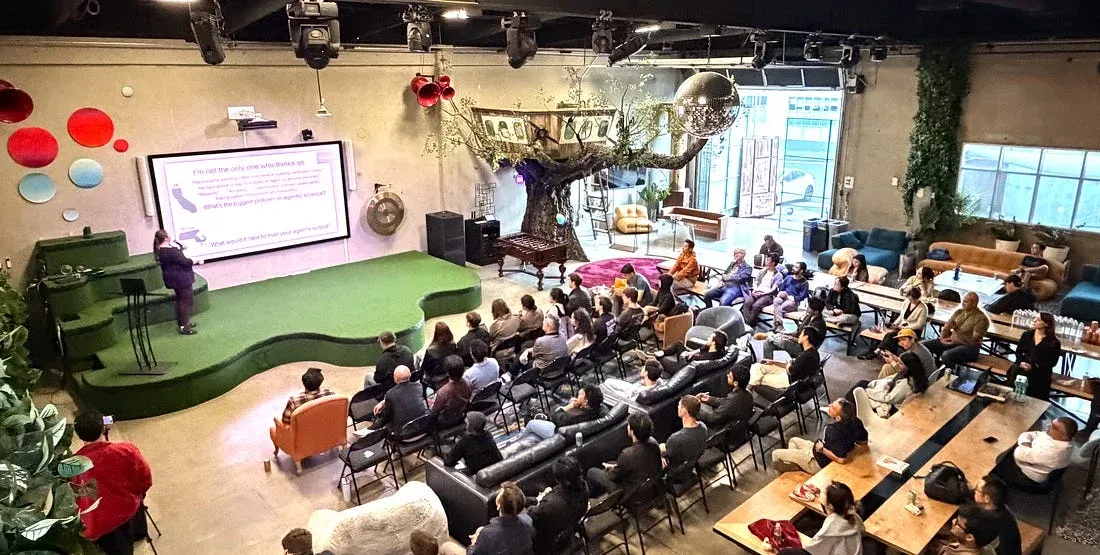
Thanks to everyone who joined our demo night. The conversations explored where new machine-learning and robotic workflows fit in the lab.
If you want to follow up with a specific fellow and what they built, the projects and links are below. We also opened applications for the next free, virtual fellowship for people who want to build new projects in community.
These demos came from a 100-day fellowship
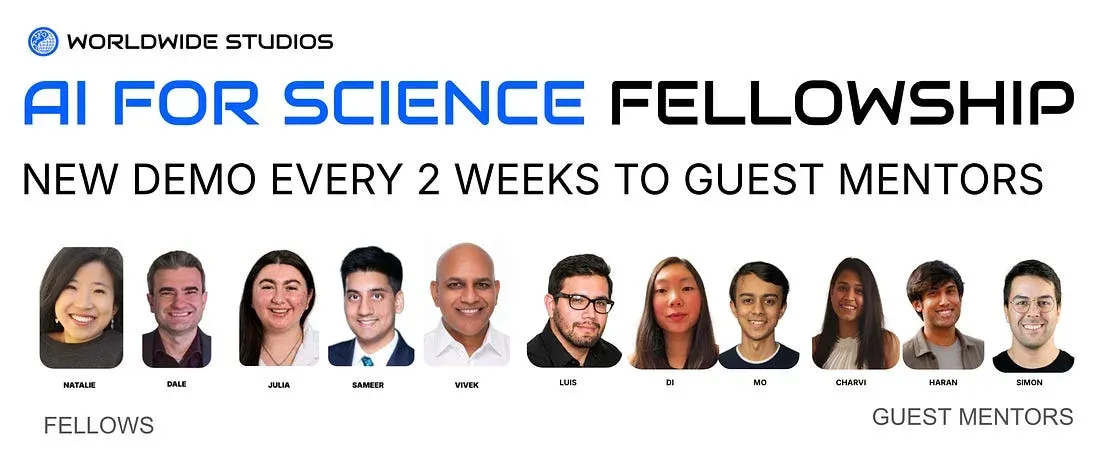
Each fellow built and shared something new every two weeks during a free 100-day fellowship hosted by Worldwide Studios—an education nonprofit helping people of all backgrounds build with the latest AI and robotics tools.
Thank you to the community mentors who supported these projects: Luis, Di, Mo, Charvi, Haran, Simon, Srusti, Elvan, Nikhil, and many more.
Learn more about the AI for Science Fellowship.
Demos and recap
1. Natalie demoed Benchmate, an AI labmate that closes the loop
Benchmate is a free, open-source AI “labmate” from Natalie that supports all four stages of the scientific process. It pulls PubMed evidence and Geneformer perturbation predictions, generates and ranks hypotheses through a seven-agent system inspired by DeepMind’s Co-scientist, designs wet-lab protocols—including reading freezer boxes with CryoVision—and analyzes raw results to propose sharper follow-ups.
Benchmate is live at benchmate.streamlit.app with a bring-your-own API key.
2. Dale demoed a DIY self-driving cell-culture lab
Dale, a mechanical CAD designer from industrial automation, is building a modular self-driving lab for cell-culture viability studies with benchtop reliability at scale. His keystone build is a heater-shaker prototyped for roughly $100 in components using makerspace electronics, salvaged printer stepper motors, and 3D-printed PETG. It can be controlled through a local touchscreen, web client, or automated workflow.
He also worked on a decapper with an industrial collet design, a flask tipper, a mobile robot, a salvaged six-axis arm, a gantry microscope, and a Blockly interface for an OT-1. Claude helped calibrate hardware from photographs. Next up: finish the instruments with food-coloring tests, make them washdown compatible, and grow actual cells. Dale is looking for fellowship or after-hours collaborators.
3. Sameer paired computer vision with wearable data for tennis
Sameer, a lifelong tennis player, built a prototype to answer whether a bad performance comes from fatigue or technique. He paired physiological data—readiness, sleep, and HRV—with pose data extracted from his own match video using Google MediaPipe and custom Python, measuring signals such as peak racket-hand speed.
His N-of-one findings showed a strong correlation between high readiness and higher swing speed, connecting physiological readiness with tennis technique in a way existing tools do not. He arrived here after pivoting from a reaction-time hardware device to a software version and then a coaching dashboard.
4. Julia built an observability layer for agent runs
Julia built watch agent run, a repository that turns opaque agent logs into deterministic readouts: input/output tables, color-coded views, and a provenance report. Scientists can compare what an agent claims it did with what append-only logs show actually happened.
She demonstrated the tool on macrophage differentiation protocols extracted from papers. Three prompting approaches looked identical at eight papers but diverged sharply at 200. Every run claimed full coverage; only one achieved it.
What you can see, you can begin to trust.
Julia is asking life-sciences researchers what they wish they could inspect.
5. Vivek demoed an AI drug-discovery engine for rare diseases
Vivek, a 20-year Genentech drug-discovery veteran, built a rare-disease platform that uses precomputed multilevel biological representations to power two world models. One generates personalized mechanistic disease hypotheses; the other designs patient-specific AAV therapeutics. Pareto frontiers balance biologist intuition with machine-learning exploration.
The demo focused on Duchenne muscular dystrophy. Vivek built it because he cares about making a difference in a heartbreaking disease landscape, and credited the fellowship for the confidence that comes from making something real.
Upcoming fellowship
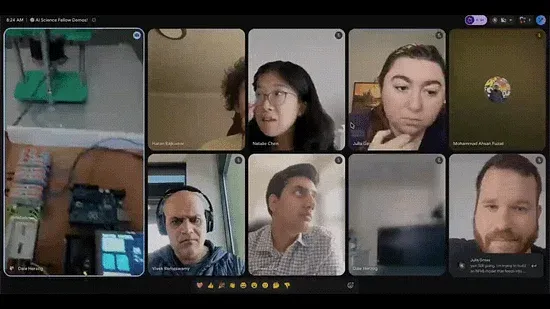
This was our first 100-day fellowship for people curious to explore what is possible in new scientific workflows.
The next cohort is free, virtual, and part time. Fellows spend 8–10 hours a week building projects in community, meet once a week, and demo every two weeks.
The first round of applications is due August 28.
Thank you to our venue host
Edison Scientific is building an AI platform that reads, reasons, and experiments across scientific disciplines—from literature synthesis and hypothesis generation to full research workflows.
A commercial spinout of the AI research lab FutureHouse, Edison is behind Kosmos, an autonomous AI scientist used by researchers at universities, national labs, and biopharma companies.
Thank you to Leina for all the help. See you at a future community event.