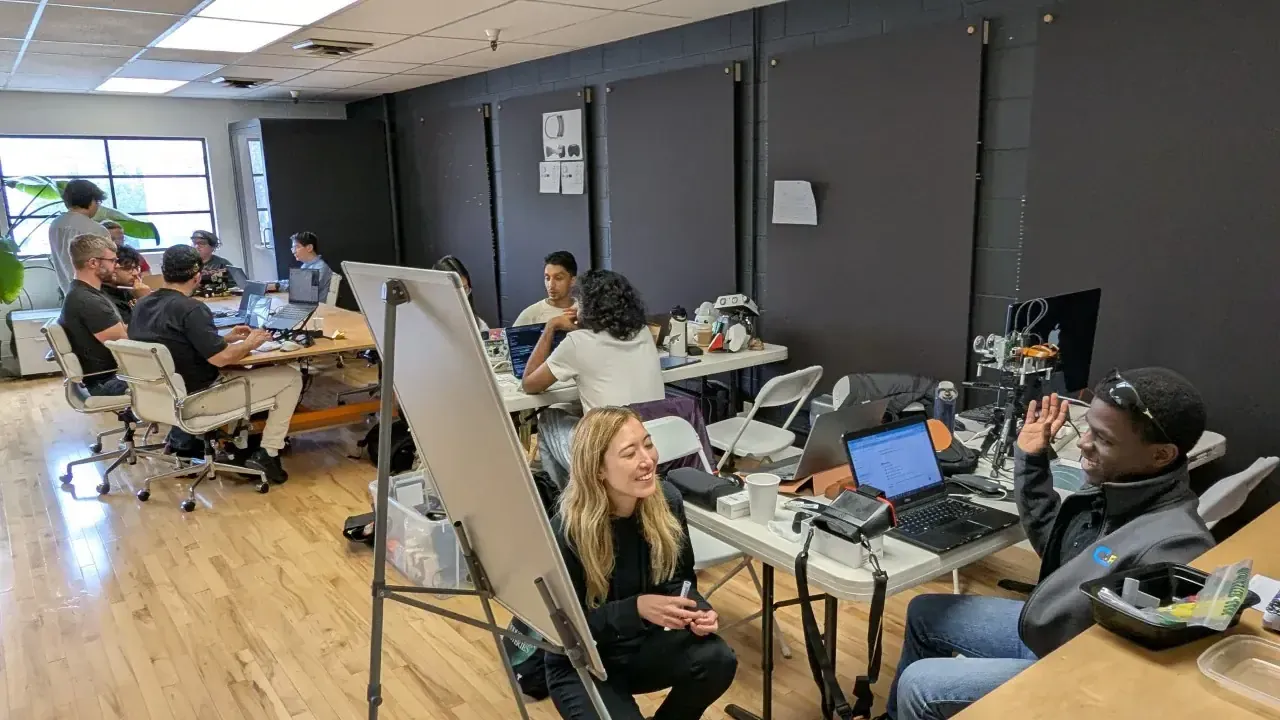
The Summer 2025 AI for Hardware Fellowship brought builders together across San Francisco, New York, Seattle, and a virtual track to make progress on physical products. With Boost VC, Flux, PamirAI, Hardware Meetup, and local hosts, we ran a 30-day hybrid program with office hours, feedback, build sessions, and demos.
More than 200 people signed up, over 100 joined in person, and eight teams presented at the final demo. The projects ranged from a companion robot and a neurotechnology developer kit to PCB design software and low-cost ocean monitoring.

Why build hardware together?
Physical products are difficult to build alone. Builders need access to parts, tools, manufacturing knowledge, feedback, and people who can work across software and hardware. This program combined local build spaces with an online community so teams in different cities could share progress and learn from each other.
New AI tools also made it easier for small teams to move between disciplines: writing firmware, designing circuits, testing prototypes, and exploring products that sense and act in the physical world. The aim was to get those tools into builders’ hands and see what they could make in a month.
Eight final demos
1. Neo AGF: a buildable brain-computer interface
Neo AGF worked on a headset for tracking focus through EEG, with a developer kit in mind. During the program, the team assembled sensors and 3D-printed headset parts, streamed EEG data over Bluetooth, built a live brain visualization app, and received its first preorders. The team planned to make 100 developer units next.
Team: Patrik Slachta, Massimo Bardetti, Rohit K., Chaitanya Polapragada, and Shreeram.
2. Circuit Synth: designing PCBs with Python
Circuit Synth built a Python library for defining correct connections in KiCad and explored an agent workflow that could move from a schematic toward a manufactured board. The team treated common components as reusable code, making circuit design easier to check and repeat.
Team: Shane Mattner, Varun R, and Kumuda Subramanyam.
3. Fable Engineering: Zero, a playful home robot
Zero is an open-design companion robot with navigation, vision, speech, and an app for programming its behavior. Over 30 days, the team printed parts, completed wiring, and trained a motion policy. They were targeting a price below $500 and had early interest from parents.
Team: Pierre-Louis Soulié and Kush Dasadia.
4. Smart Case: health sensors in a phone case
Angel combined a breathalyzer, body-temperature sensor, and UV sensor in a phone case. The team revised the ribbon-cable PCB for better signal integrity, worked on a blood-alcohol estimate, and explored how AI might predict time to sobriety.
Team: Angel.
5. USV: lower-cost ocean data
Eduardo built an unmanned surface vehicle to collect coastal environmental and bathymetric data. During the program, he advanced the vehicle’s winch and investigated a path to a first customer among ports and fish farms.
Team: Eduardo.
6. Amygdala Modulation: a portable neuro-wellness device
This team explored a non-invasive device intended to use electromagnetic frequencies for stress-related wellness. It was presented as an early prototype and concept, not a validated medical treatment.
Team: Xavier (Weijia) Huang and Lyndsey.
7. Cuts: physical shortcuts for everyday AI
Cuts prototyped a small gesture-activated device that captures context from the physical world and asks AI for immediate feedback. An early use case was outfit advice through a connected mirror and a digital closet, with possible links to thrift shopping.
Team lead: Sumedh Supe.
8. Vectometra: portable motion capture
Vectometra explored a lightweight, camera-free wearable for detailed motion capture. Its goal was to make capture more portable and less expensive than studio-based optical systems, with a device for each joint and a software service around the data.
Team lead: Nikhil Dubey.
What we learned
The mix of local sessions and online check-ins helped builders from different backgrounds exchange ideas and keep moving. Access to mentors, hardware tools, and public demos gave teams a deadline and a reason to show real work. For a future cohort, we wanted to improve onboarding for teams, strengthen support in each city, and provide more focused build tracks.
Thank you to the people who made it possible
Emily Yu and the Boost VC team supported builders from the first day. Lance Cassidy, Ryan Fitzgerald, Nicolas Tzovanis, and Flux helped teams work with AI-assisted PCB design. Tianqi Ye and PamirAI got boards into builders’ hands. Vinny Pham brought XREAL glasses for people to try.
Thanks to Nate Padgett and Studio 45 in San Francisco; Patrick Astarita and Andrew Rose with Fractal Tech in New York; Dylan Holland, Steven Dourmashkin, Chiplytics, and Leon Zhang in Seattle; and Jace Martin, Paul Vizzio, and Hardware Meetup for connecting builders across cities.
Mentors Nick Grafakos, Emily Yu, Yash Oza, Jeremy Kuempel, and Ryan Fitzgerald gave teams feedback. Daria Palenova, Jordan White, and Nima Zeighami judged the demos.
This recap adapts Michael Raspuzzi’s first-demo notes from August 4 and final-demo recap from August 21.